
Casino Dice Games in the UK: Formats and Play
 Available in GB
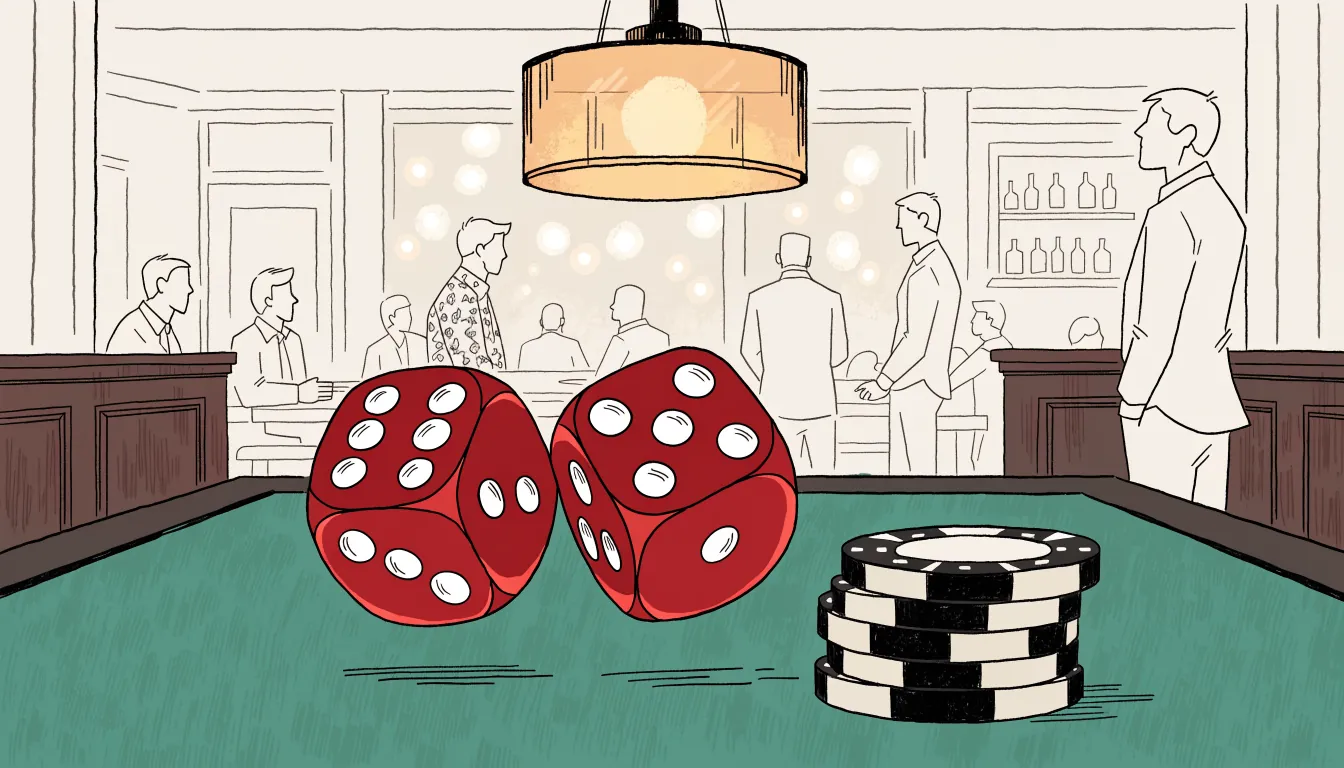
Dice can feature in table games, machine-based games and computer-generated play, so the format matters as much as the roll.
How Casino Dice Games Fit Into the Casino Game Mix
A dice game can sit in more than one part of the casino game mix. The word “dice” describes an element of play, not necessarily the format, equipment or way a game is run. To classify casino dice games accurately, it helps to separate three categories: casino games as a broad activity, gambling machines, and table games. Random-number games describe another feature: how outcomes are generated.
At the broadest level, a casino game involves staking cash or chips on a possible random result, or on a combination of results. That definition covers more than games played at a physical table. The format depends on how the game is presented and operated. Dice might be part of a table game, or appear within a machine-based or computer-generated game. The presence of dice alone does not establish which category applies.
Table games and dice
A table game is defined by the relationship between the player and the casino. Players compete against the casino, not against one another, and a croupier or dealer usually conducts the game. A dice game presented at a table may therefore belong to this category when those features are present.
The distinction matters because “dice table games” is not a complete classification by itself. It identifies the equipment or theme, but not who runs the game or who the player is competing against. A game involving dice could be organised around a dealer-led table, while another dice-based format might not use a table or involve casino staff. Those are different ways of presenting play, even if both feature a roll or a dice-like result.
Machines and computer-generated results
Gambling machines are generally designed for one player at a time and do not require an employee of the casino to operate each play. A dice-related game presented through a machine can fit that category, regardless of whether its screen depicts dice. The relevant point is the delivery format, not the image used on it.
Casino Games: Slots, Table Games and Live Play · Online Casino American Roulette UK: Rules and Bets
Random-number games are classified by how the outcome is produced. A computer or other gaming equipment generates selected random numbers, which determine the result. That description does not, by itself, say whether the player is using a machine, sitting at a table, or interacting with another format. In other words, “random-number game” concerns the source of the result; “machine game” concerns how play is delivered. The labels can describe different aspects of the same game rather than competing categories.
This distinction is useful when comparing online presentations with traditional casino settings. A physical table game may be conducted by a dealer, while an online game may use computer-generated numbers. Both can involve a casino game and a wager, but the operating format differs. A dice image on screen does not establish that a physical die is being rolled, just as a table-like layout does not establish that a croupier is involved.
What “dice game” tells you—and what it does not
The phrase “casino games with dice” is broad. It may refer to a table game where dice are central to play, a machine that uses dice imagery, or a computer-based game whose result is represented as a dice outcome. The category becomes clearer only when the format and operation are considered alongside the equipment.
Online Casino Games for Real Cash in the UK
For casino games involving dice, the practical questions are therefore structural: is play conducted at a table or through a machine; does a dealer take part; and is the outcome generated by gaming equipment? Those details distinguish table games from machine games and explain how random-number generation fits into either format. Without them, “dice game” names a feature, not a complete description of the game.
This framework also prevents a common category error: treating every dice-themed presentation as a dice table game. Some casino dice games may be table-based, while others may be delivered as machine or computer games. The format determines the category; the dice determine only what part of the game is being highlighted.
Our top casino picks for the UK
- BeOnBetBonus: 100% up to €500 + 100 FS · Payout speed: 1-3 business days
- AmunbetBonus: Join now and get 450% up to 2,700 GBP + 450 FS · Payout speed: 1-3 business days
- Revery PlayBonus: 100% up to€1,000+ 100 FS · Payout speed: 1-3 business days
- JetsetspinsBonus: 200% Bonus + 100 Free Spins + Free Royal Wheel · Payout speed: 1-3 business days
- ChanzeBonus: Slots Welcome Bonus #1 200% up to €500 · Payout speed: 1-3 business days
- BritsinoBonus: Welcome Package – Get your £2,200 + 2,000 FS · Payout speed: 1-3 business days
- DieselwinBonus: Welcome Pack 250% up to £4000 + 200 FS · Payout speed: 1-3 business days
- NightWinBonus: £900 + 400 free spins · Payout speed: 1-3 business days
- SlotoSportBonus: 500% up to £ 10 200+ 777 FS · Payout speed: 1-3 business days
Dice Casinos and the UK Market: Regulated and Offshore Are Different
For someone looking for a dice casino in the UK, the central distinction is not the game’s theme or format. It is whether the operator holds the licence required to serve British customers. Sites can be accessible from the same country while occupying different positions under UK gambling law; accessibility is not evidence of authorisation.
Accessibility does not equal authorisation; being able to access a site from the UK is not evidence that the operator holds a UKGC licence.
A specialist review has described the UK online casino market in 2026 as two parallel environments: the UKGC-regulated market and offshore platforms outside the UKGC system. That description is useful as a map of what a player may encounter, but it does not make the two environments equivalent. The legal boundary is defined by the operator’s licence, not by the fact that a site accepts UK players or displays games associated with casino dice.
What the licensing boundary means
The Gambling (Licensing and Advertising) Act 2014 established the requirement for operators seeking to take bets from British residents to hold a licence. In practice, remote gambling operators selling into the British market must hold the relevant UKGC licence, regardless of where the business is based. An operator cannot avoid the requirement simply by locating its company or servers outside Britain.
The rule applies to the service being offered to British customers. A platform may be based offshore and still accept players from the UK, but accepting those players does not bring it within the UKGC system. Offshore casinos that accept UK players operate outside that regulatory framework and do not hold a UKGC licence. Their availability is a market fact; it is not a substitute for authorisation.
That difference matters when the word “UK” appears in a site’s description. It may refer to the audience the operator accepts, rather than to a UK licence or regulation by the UKGC. The label alone establishes neither. The relevant question is whether the operator is licensed to provide remote gambling to consumers in Great Britain.
Chicken Road Casino Game in the UK: Formats and Risks
Two environments, not two forms of the same status
UKGC-licensed casinos and offshore casinos are sometimes presented side by side because both may be reachable by British players. That is a practical comparison, not a legal one. A UKGC licence places an operator within the British regulatory system; an offshore platform without that licence sits outside it. A familiar interface, a dice-related game, or a British-facing page does not change that status.
The distinction also prevents a common category error: treating “accepts UK players” as equivalent to “licensed in the UK”. The first describes who can access an operator’s service. The second describes its regulatory permission to offer that service in the British market. They are different claims, and only the second answers the licensing question.
Accordingly, descriptions such as “UK dice casino” need careful interpretation. They may identify a casino aimed at UK players, but they do not confirm that the operator holds a UKGC licence. The market includes offshore platforms that accept British customers, yet the legal requirement remains that operators taking bets from British residents must hold the appropriate licence. Geographic access and regulatory approval should not be collapsed into one label.
This is why a ranking of “best” or “top” dice casinos cannot be treated as a reliable statement about legal standing merely because the sites are grouped together. A list can place licensed and offshore operators in the same visual frame without making their status the same. For a UK-facing casino, the licence question comes before any judgement about presentation or game selection.
Attention An operator’s self-description as ‘international’ or ”suitable for UK players’ does not establish that they are licensed to serve Great Britain.
The wording of an operator’s own description is not the legal test either. A site may call itself international, offshore, or suitable for UK players; those terms do not establish that it is licensed to serve Great Britain. Conversely, the location of an operator outside the country does not remove the licensing obligation when it takes bets from British residents. The relevant boundary follows the market served, not the company’s address.
Why the distinction comes first
For online dice casinos, the game itself does not determine whether the operator is authorised. The same broad casino category can be offered by businesses with different regulatory status. The sensible first division is therefore between a service operating under a UKGC licence and one operating outside that system. Only after that is clear can other site characteristics be assessed without confusing access with legal permission.
In short, the UK market contains both regulated operators and offshore platforms that accept UK players, but those are not interchangeable forms of a UK-licensed casino. Since the 2014 Act, an operator taking bets from British residents must hold a licence. That requirement is the dividing line, irrespective of where the operator is based or how a dice game is presented.
Online Dice Play: The House Edge and Short-Term Outcomes
The financial structure of an online casino game has two time horizons. Across repeated play, the rules are arranged to give the casino a predictable advantage. Over a shorter run, a player can still finish ahead. Those statements do not conflict: a long-term expectation describes the direction of results across many outcomes, not the result of one session.
Mines Casino Game UK: How Risk and Cash-Out Work
That distinction matters when assessing an online dice casino. A win is an actual short-term outcome, but it does not establish that the game has become favourable to the player or that later results will compensate for earlier losses. Equally, a loss during one session does not prove that the underlying odds have changed. The casino’s advantage is a feature of the game’s financial structure, while individual results remain uncertain.
Expected return is not a session forecast
The house edge is commonly used to describe the casino’s long-run advantage. It should not be read as a promise about what will happen to a particular balance during a particular visit. Long-run tendencies become meaningful across repeated outcomes; a short session can produce a result that sits far from that tendency, including a gain.
For someone considering casino dice online, the key point is that the possibility of a short-term win sits alongside the casino’s structural advantage. A winning streak is not evidence that the next outcome is more likely to favour the player. A losing streak is not evidence that a win is now due. Treating either pattern as a forecast adds a rule that the game’s financial structure does not provide.
This is also why the amount won in one session cannot, by itself, describe whether a game is favourable. The relevant distinction is between the outcome that occurred and the advantage built into play over time. A player can leave with more than they started with, while the casino still retains its long-term edge across play as a whole.
A balance can rise without changing the underlying economics
A balance is a record of realised outcomes, not a measure of the game’s long-term fairness. If a player wins, the balance may increase; if losses follow, it may fall. Neither movement changes the casino’s underlying advantage. The same game structure can therefore produce different short-term paths for different players, or for the same player in separate sessions.
Essential Distinction
Individual session results are uncertain and do not change the casino’s underlying long-run mathematical advantage.
Online casino dice games remain casino games in this respect: access through a screen does not remove the difference between short-term results and long-run economics. Casino games are available through online casinos where permitted by law, but the way a game is delivered does not turn an uncertain run of outcomes into a predictable income stream.
A useful mental account is to keep three things separate: the stake committed, the result of each outcome, and the balance remaining after play. A positive balance at one point records a gain to that point; it does not establish what the next outcome will be. Likewise, an earlier loss is money already lost, not a credit that the game must repay. Past results do not rewrite the terms of the next round.
Why the edge matters even when the player wins
The casino’s advantage is not a claim that every player loses every time. It describes the expected direction of results over repeated play under the game’s rules. Individual outcomes can depart from that direction, sometimes substantially in the short term. That is how the casino can offer the possibility of gains without giving up its long-term advantage.
For a person deciding whether to play dice games online in a casino, the financial question is therefore not simply whether a win is possible; it is. The more relevant point is that a possible win and a casino advantage can coexist. Any short-term success is an outcome, not proof that continued play has become a sound way to recover losses or generate dependable returns.
JetX Casino Game in the UK: Categories and Play
This distinction applies whether play is described as online casino dice or casino dice played online. The format does not alter the basic relationship between uncertain results and the casino’s long-term position. A result can be favourable to the player, but the game’s overall structure still gives the casino its predictable advantage across repeated play.
Dice-Themed Slots and the Limits of What Can Be Named
A slot with dice imagery is still a machine game, not necessarily a table game in which a player throws dice. The theme may show dice on the reels or use a roll as part of its presentation, but appearance alone does not establish how the game works. The relevant distinction is the format of play: gambling machines are generally used by one player at a time and do not require a dealer or other casino employee.
That distinction matters when comparing a dice-themed slot with a casino game built around a dice roll. A machine may generate outcomes through its own game system, while a random number game uses selected numbers produced by a computer or other gaming equipment. Dice graphics do not, by themselves, reveal which category applies. Nor do they establish that the player is making decisions about a physical or simulated throw.
The phrase “dice slot” therefore covers a visual theme, not a single defined game format. A title that depicts three dice, for instance, cannot be classified from that detail alone. The same applies to games that present a roll as a central image or animation: the display is not a rulebook.
The sounder comparison is between the machine format and a game whose rules actually centre on dice outcomes.
Understanding Dice Slots
A slot with dice imagery is a machine game, not a table game, regardless of the visual theme.
The distinction also keeps “free” separate from “dice-themed”. Whether a particular machine can be played without staking money depends on its own available mode and conditions; the theme does not answer that question. A dice motif may make a slot look like a throwing game, but it does not turn the machine into one.
What a Dice Roll Slot Demo or Free Play Can—and Cannot—Establish
A free-play screen can show how a dice-themed slot presents its interface, but it does not establish the financial conditions of real-money casino play. The distinction is fundamental: casino gambling involves staking cash or chips on possible random outcomes or combinations of outcomes. A demonstration without a stake does not reproduce that transaction.
Online availability is a separate matter. Casino games can be offered through online casinos where permitted by law. That does not mean every game has a demo mode, or that free access is available on every platform. Nor does the word “free” establish what happens if a game later moves to paid play. The display may resemble the real-money version while the financial conditions are different.
A dice roll slot, a dice-themed slot game and a casino dice game are not interchangeable descriptions. A slot uses a machine-style interface; casino dice play refers to gambling on dice outcomes. A screen featuring dice does not, by itself, show which category a game belongs to. The visible theme is not evidence of the underlying format.
Crash Casino Games in the UK: How They Work
What a demo can show
A demo may let a player observe the screen layout, controls and sequence of play without risking cash or chips. It can indicate how a particular game presents its possible outcomes. That is a limited demonstration of the interface, not proof of what a paid session will cost or return.
Free play also cannot establish that a player can withdraw anything from the session. Without a real stake, there is no financial result equivalent to wagering cash or chips. Any apparent balance in a demonstration should therefore be treated as part of the display, not as money available to cash out.
The same limit applies to searches for “roll the dice” slot free play or dice-and-roll slot demos. The wording suggests a format, but the title or image alone cannot verify whether a particular offering is a slot, a table game, or something else. The relevant distinction is the actual play structure, not the dice graphic.
What it cannot teach about casino dice
A slot demo is not a substitute for learning how to play casino dice. It does not, merely by showing dice, explain the rules, stakes or outcome structure of a table game. The same applies to craps: a slot interface with dice imagery is not instruction in how craps is played at a casino.
For an accurate comparison, the game’s own description must identify what is being played and whether the session involves a stake. Free access can clarify presentation; it cannot turn one game category into another or establish the terms of real-money play. When those details are absent, the only firm conclusion is that the demonstration shows a screen, not the complete financial arrangement.
Caution A free-play or demo mode does not reflect the financial conditions or the ability to withdraw funds in real-money play.
Choosing a Dice Casino Site by Its Verifiable Conditions
A dice casino site is not made trustworthy by a dice graphic, a broad game menu or a polished landing page. The useful checks concern who operates the platform, which licence applies to its activity, and what account protections are available. These are separate questions: a visible control can make account management easier, but it does not establish that the operator is authorised to serve people in Great Britain.
For real-money gambling offered to customers in England, Scotland and Wales, the operator must hold a UK Gambling Commission licence. A platform operating outside that system does not become a UKGC-licensed casino because it accepts British customers, describes itself as international or displays a licence issued elsewhere. Non GamStop sites may present a different regulatory arrangement, but that does not alter the UK licensing requirement for operators taking bets from British residents.
Check the operator, not the branding
The first practical task is to identify the legal operator behind the site and compare that identity with its licensing information. The name in promotional material may be a brand; the entity responsible for the gambling service is the detail that matters. If the operator’s identity or licence status is difficult to establish, the uncertainty is itself relevant to the decision.
A licence from another jurisdiction is not a substitute for a UKGC licence when the operator is serving the British market. Non-traditional gaming platforms may operate under licences from Curaçao, Malta or Gibraltar. That information describes their stated regulatory setting; it does not make the platform part of the UKGC system. The distinction should be kept plain rather than hidden under labels such as “global” or “international”.
Aviator Casino Game UK: Facts, Rules and Bonuses
This is why a list of supposedly trusted dice casinos would be a poor substitute for checking conditions. A ranking can change, and a label cannot resolve which company holds the account relationship or which regulator covers the service. The relevant standard is verifiable operator information, not the confidence of the site’s own wording.
Treat platform controls as a separate check
Alternative platforms generally provide their own player protection features. These can include deposit limits, session timers and self-exclusion options. Their presence is worth confirming in the account area and the terms governing how each control works. A feature name alone is not the same as an available, usable control.
Deposit limits address the amount that can be added to an account; session timers provide a way to monitor time spent on the platform; self-exclusion is a more substantial restriction on access. These tools serve different purposes and should not be treated as interchangeable. Their availability also does not establish the platform’s licensing status. Regulatory standing and account safeguards are two distinct lines of assessment.
For a UKGC-licensed operator, protection duties sit within the UK regulatory framework. On a platform outside that framework, its own tools may still be present, but they are provided by the platform rather than proving UKGC oversight. That difference affects what can be inferred from a control being displayed: it is evidence of a stated feature, not evidence of local licensing.
Separate dice presentation from site conditions
Searches for a casino game with dice can lead to sites presenting dice-themed machines, table formats or other random games under one broad label. That presentation does not answer whether the operator is licensed or whether account protections are accessible. A game category and a site’s regulatory position are independent checks.
Site Verification Checklist
- Identify the legal operator behind the brand
- Verify the existence of a UKGC licence
- Confirm availability of player protection tools
- Check account management settings
The same applies to dice slots and other dice-themed machine games. Their artwork or title may suggest a particular style of play, but it does not establish who operates the casino. A site assessment should therefore begin with the company and its licence details, then move to the controls available to manage the account. Choosing by theme first leaves the more consequential conditions unresolved.
A platform may also use the language of safety without making the underlying arrangement clear. Useful information is specific: the operator’s legal identity, the regulator it says oversees its activity, and the location of deposit limits, session timers and self-exclusion settings. General assurances such as “secure” or “trusted” do not replace those details.
The central distinction is straightforward. A site can display player-protection features and still operate outside the UKGC system; a licence from another jurisdiction does not satisfy the UK requirement for operators serving British residents. Conversely, checking a licence does not show whether the platform’s controls are easy to find or how they are applied. Each condition needs its own evidence, and neither branding nor a dice-themed catalogue can stand in for it.
Craps, Crypto Dice and the Difference Between House and Player Competition
Craps is commonly associated with casino dice play, but the label alone does not establish how a particular online game is structured. The useful distinction is who the player is competing against. In a house-banked game, the casino takes the opposite position to the player’s wager; in a player-versus-player format, the casino need not be the opponent.
That difference affects how the operator earns revenue. Where players compete against the house, the casino’s return is built into the game’s terms. Where players do not compete against the house, poker being one example, casinos usually earn through a commission known as a rake. The operator charges for running the game rather than relying on the same house-versus-player arrangement. Treating both structures as if they were identical obscures the actual cost model.
Live Dream Catcher Casino UK: Game and Operator
“Crypto dice” describes a payment or presentation context, not a complete explanation of the game’s mechanics. A dice game involving cryptocurrency can still be house-banked, while a format using digital assets does not become player-versus-player merely because the currency is different. The relevant details are the rules, the counterparty to each wager and the way the platform takes its revenue.
A specialist review has reported that some alternative platforms accept Bitcoin, Ethereum and Litecoin alongside conventional cards and e-wallets. That is a platform-specific report, not a basis for assuming that every crypto dice casino offers the same currencies or payment methods. Currency availability also does not, by itself, identify whether a game is craps, another dice format or a player-versus-player product.
The practical comparison is therefore structural rather than cosmetic: dice imagery, cryptocurrency support and a casino label do not reveal who carries the opposing position or how the operator is paid. For craps-style play, the defining point is whether the wager is made against the house. For games without house competition, the rake model is the relevant distinction. A platform’s own rules and fee terms determine which arrangement applies.
Casino Dice in 2026: Bonus Terms in Pounds and Wagering
A casino dice bonus is not measured by its headline amount alone. The amount of bonus funds and the wagering requirement together determine the total stakes attached to the offer. A £20 bonus with 10x wagering requires £200 in bets before the wagering condition is met. That is turnover, not a target profit or a promise that £200 will remain in the account.
Bonus Turnover Calculation
Step 1: Identify the bonus
Start with the initial bonus amount, for example £20.
Step 2: Apply the wagering multiple
Multiply the bonus amount by the wagering requirement (e.g., 10x).
Step 3: Calculate total turnover
£20 × 10 = £200 in total required stakes.
The calculation is:
Bonus funds × wagering multiple = required total stakes
Since 19 January 2026, a gambling incentive cannot impose wagering requirements above 10x the bonus funds. At that cap, every £20 of bonus funds corresponds to £200 in required stakes. The number is a ceiling on the wagering multiple, not a statement that every offer uses the maximum. The offer’s terms still need to specify the applicable amount and how wagering is counted.
The distinction matters for casino dice play because a bonus can be tied to one gambling product type, while its wagering condition defines the activity that counts towards release. An incentive cannot require play across different product types, such as casino games and betting, to unlock the same reward. A combined offer that makes both kinds of gambling a condition does not fit that rule.
The arithmetic should be read before the promotional amount is treated as available value. If the bonus is £20 and its stated requirement is 10x, the relevant commitment is £200 in total stakes. If the stated multiple is lower, the required turnover falls in the same proportion. The bonus balance itself is not the amount that must be wagered, and completing the turnover condition does not mean that the original bonus amount will necessarily be available for withdrawal; the offer’s other terms determine that.
For dice games, the useful comparison is therefore between the bonus amount, its permitted wagering multiple and the eligible product category. A large headline figure can still carry substantial turnover. A smaller bonus with a lower requirement may involve less total staking. The pounds attached to the condition give the offer a clearer value than its promotional label.
Crazy Time Live Casino Game Show: UK Guide
Bitcoin Dice Casinos: Payment Options and Withdrawal Timing
Payment choice is a separate condition from the game itself. A specialist review of alternative platforms reports that some may accept Bitcoin, Ethereum or Litecoin alongside conventional cards and e-wallets. That is a description of reported options, not a guarantee that every platform supports each method. Availability can depend on the operator and the account, so the listed method needs to match the deposit and withdrawal rules shown at the point of payment.
Bank transfers have changed as well. Open Banking rails and Faster Payments have reduced friction when moving money to and from online casinos. These routes are relevant alongside cryptocurrency, cards and e-wallets: the useful comparison is not simply whether a deposit can be made, but whether the same route can be used for a withdrawal and what conditions apply to it.
Timing claims need the same qualification. A specialist review reports that many platforms provide instant deposits and complete withdrawals within hours rather than days. “Many” does not mean all, and a reported processing time is not a settlement promise for an individual transaction. Deposit speed and withdrawal speed are separate measures; an instant deposit says nothing by itself about how quickly a withdrawal is approved or reaches its destination.
Online Bingo UK: Tickets, Games and Real-Money Play
For a bitcoin dice casino, the practical record to establish is therefore the supported currency, any conversion or transfer steps, whether withdrawals must return through the deposit method, and the stated processing window. The same checks apply when the chosen game is Sic Bo: a dice game does not determine the payment rail or settlement schedule. A dice casino bonus also does not change the underlying payment method; its conditions belong to the offer, while transaction timing belongs to the cashier terms.
The final amount received can depend on the route’s own charges or conversion, so the displayed balance and the amount arriving in a bank account or wallet may not be identical. No single timing claim covers every currency, payment method and transaction. A useful comparison records the method, the quoted withdrawal window and the net amount expected, rather than treating a fast deposit as evidence of a fast cash-out.
Games
Monopoly Live Casino UK: How the Game Works
Monopoly Live pairs a host-led studio broadcast with a wheel whose segments determine the game’s outcomes. What Monopoly Live Puts on the Table Monopoly Live is a live casino game…
Best Live Casino UK: Games, Dealers and Conditions
See how live tables combine real dealers, streamed play and digital controls,…
Online Slots Payout Percentage: What RTP Measures
RTP describes theoretical prize returns across extensive play, not the outcome of…
Online Casino American Roulette UK: Rules and Bets
A guide to American roulette’s double-zero layout, betting options, payouts and practical…
Written by the editors at StakeVault.