
Plinko Casino UK: Games, Rules and Real-Money Play
 Available in GB
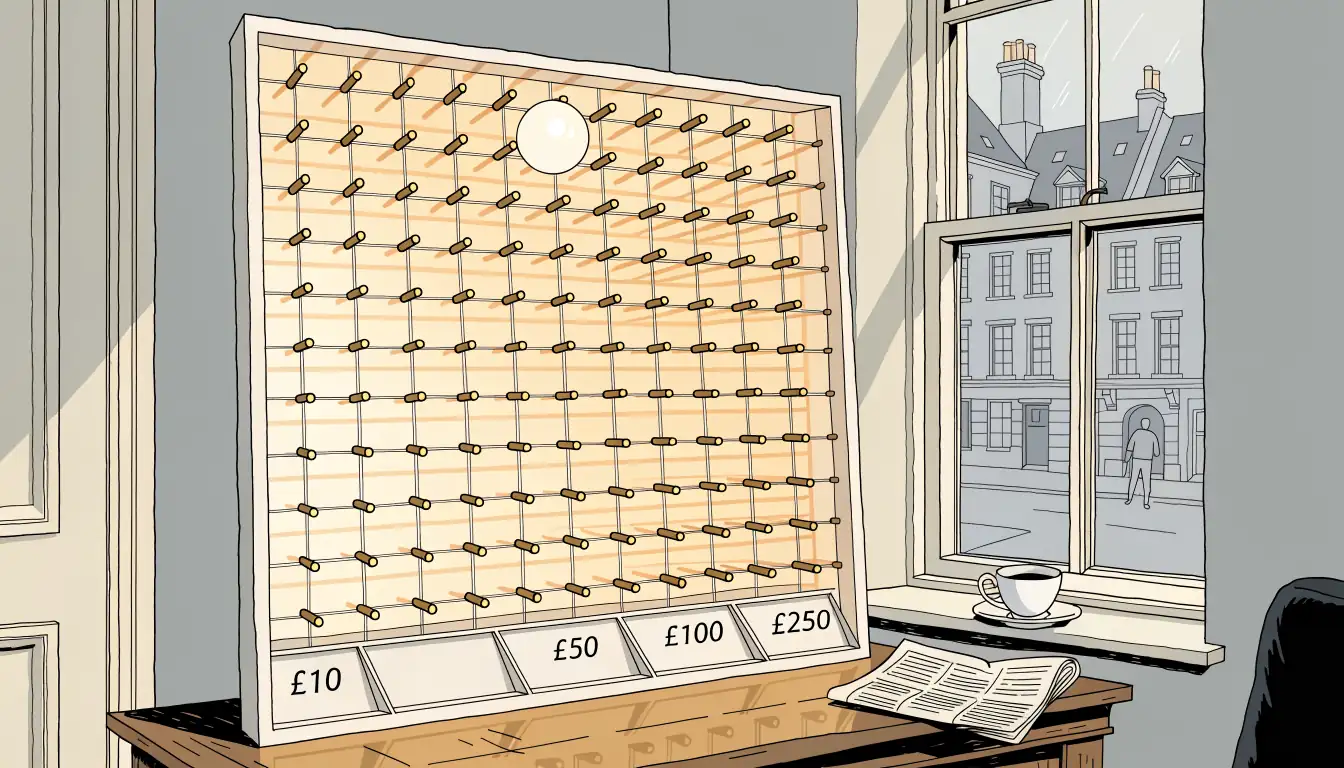
Explore how Plinko works, what affects cashable winnings, and how licensing, bonuses, free play and mobile access shape the experience.
How Plinko Fits into the Online Casino Game Mix
Plinko belongs to the broad family of chance-based casino games, but its appearance can make it seem closer to a machine game than to a traditional table game. A token or ball moves through a board of pegs towards a set of outcome slots. The visual path is easy to follow; the category depends less on the animation than on what determines the result and how the game is operated.
Online casinos can offer casino games where this is lawful. Within that setting, the useful distinction is between games governed by computer-generated random numbers, gambling machines and dealer-led tables. These categories may overlap in presentation: an electronic game can look like a physical machine, while a digital table can reproduce the layout of a live one. The interface alone does not establish the underlying format.
Random-number games
A random-number game uses selected numbers produced by a computer or other gaming equipment to determine outcomes. Plinko commonly fits this broad model when the computer decides the ball’s route or final position through its random-number process. The pegs and movement provide a visible representation of the result, rather than requiring a player to control each bounce.
That distinction matters when comparing an online Plinko casino game with other casino formats. A sequence of animated events can suggest a physical process, but the animation is not, by itself, evidence that each movement is independently determined in real time. The relevant category is the mechanism used to produce the outcome. If random numbers select it, Plinko sits with other random-number games even when the screen depicts a ball travelling across a board.
The same broad class can include games with very different interfaces. One may present numbered outcomes; another may show a path, spinning object or other visual sequence. The display changes how the result is communicated, not necessarily how it is generated. For someone comparing online Plinko casino games with other digital casino titles, that is a more useful distinction than whether the screen resembles a cabinet or a board.
Monopoly Live Casino UK: How the Game Works
Gambling machines
Gambling machines are generally designed for individual use, with no casino employee needed to run each play. Their digital versions preserve that self-contained format: the player interacts with a game interface, while the system manages the round. A Plinko title can resemble this kind of game when it is presented as a standalone screen with a ball, pegs and outcome positions.
Still, “machine” describes the play format more than the visual theme. A physical machine might use a screen, buttons and software; an online version can reproduce those elements without being a piece of hardware in the player’s surroundings. If Plinko is offered as a self-contained digital game, the experience may feel machine-like, while the outcome-generation method remains the separate question. It can therefore be described both as an electronic gambling game and, where its result is set by generated numbers, as a random-number game.
This also helps clarify the phrase “Plinko slot”. It may be used informally for a Plinko title with the solitary, repeatable format associated with machine games. That label does not establish that the game is a conventional reel-based slot. The board, pegs and landing positions distinguish its presentation; the machine-like format describes how the game is played. Names used in a menu are not a substitute for understanding either feature.
Dealer-led table games
Table games follow a different pattern. Players compete against the casino, not against one another, and a croupier or dealer commonly conducts the game. The dealer manages the sequence and the table’s shared procedure; the game is not simply a solo screen producing an outcome without staff involvement.
An online table can reproduce that arrangement digitally, including a dealer-led presentation. Plinko does not become a table game simply because its board occupies a large area of the screen or because several possible outcomes are displayed at once. In its usual standalone online format, it has neither a dealer conducting a shared table nor players competing against the house through a table procedure. Its defining features are a visual path and an electronically determined outcome.
Plinko is best understood by separating its interface, its mode of play and its result-generation method.
This is why searching for an online casino with Plinko in the UK can lead to titles grouped alongside slots or other instant-play games, even when the game’s board looks unlike reels. Such grouping is a navigation choice, not a firm taxonomy. A category label may describe the format the casino uses for its catalogue, while the game itself is better understood by separating its interface, its mode of play and its result-generation method.
Plinko is therefore best placed at the intersection of random-number gaming and machine-style presentation, rather than among dealer-led tables. The distinction explains why an online Plinko game can look tactile without being a physical machine, and why it can share a catalogue section with slots without being a conventional slot. The appearance is the packaging; the operating format and source of the outcome define the game category.
What a Plinko Casino Game Involves
A Plinko casino game is a form of gambling in which a stake is placed on the possible result of a random event. The central idea is simple: an object moves through a field of pegs, changing direction as it falls, and ends in one of the available outcome positions. The stake is attached to that possible outcome, or to the set of outcomes defined by the game. The visual path may be easy to follow; the financial arrangement is still a wager.
Casino Games: Slots, Table Games and Live Play
Casino games generally involve cash or chips placed on an outcome or a combination of outcomes. In Plinko, the player is not controlling each deflection or choosing a route through the pegs. The result is determined by the game’s random process, and the display shows how that process resolves. Watching the marker bounce across the board can make the sequence feel more active than a single random draw, but movement on screen does not make the result skill-based.
The game’s layout translates possible results into a visible structure. Different landing positions may carry different values or consequences, depending on the particular version. The player’s decision concerns the wager and the options the game presents; the subsequent path is not a series of choices. That distinction matters when describing a casino Plinko game: interaction with the interface is not the same as control over the random outcome.
A Plinko game may be described as a slot-style casino game because it is played through an electronic interface, but the label alone does not explain its mechanics. Its defining presentation is a falling object and a board of pegs, rather than reels. Nor does a familiar arcade-like appearance change the underlying arrangement: a stake is exposed to an uncertain result, with the game determining where the object lands.
The word “casino” also signals a particular economic structure. Casino games are generally designed so that the operator has a predictable advantage over the long term. That does not mean every individual round produces a loss. A player can receive a favourable result and make a short-term gain; another round can produce a different result. The long-term advantage describes the overall arrangement, not a forecast of what will happen in one particular play.
Attention A single outcome is not evidence that a game is generous or unfair, as randomness does not keep accounts and settle a balance.
This is why a single outcome should not be treated as evidence that a game is generous or unfair. Random results can vary over short stretches, while the casino’s advantage is built into the game’s broader terms. A memorable win may be real, but it does not remove that structural advantage. Equally, a losing result does not prove that the next one must reverse it. Randomness does not keep accounts and settle a balance.
A casino Plinko game review therefore needs to distinguish the spectacle from the wager. The animation describes what the player sees; the rules determine what each possible landing means for the stake. A clear understanding begins with identifying which outcomes are available and what the game assigns to them. Without that distinction, the board can look like a choice of routes even when the player has no control over the object’s movement.
The same distinction applies when the game is presented as a demo or as a free Plinko game. A no-cost interface may reproduce the visual sequence, but appearance alone does not establish whether a stake is being made. In casino play, the defining gambling element is the stake placed on a possible random result. The animation is the presentation; the wager is the financial commitment.
“Plinko” can refer to a style of game rather than one identical product. Interfaces and board designs may differ, so the name by itself does not settle how a particular version handles outcomes. The stable point is the casino-game structure: a player stakes cash or chips on what may happen, and the result is uncertain. The casino, meanwhile, has a predictable long-term advantage, alongside the possibility that a player will gain in the short term. That is the basic arrangement, without confusing a bouncing marker with a strategy.
Online Bingo UK: Tickets, Games and Real-Money Play
Real-Money Plinko: Stakes, Risk and the House Edge
With real-money Plinko, each stake is cash exposed to an uncertain result, not merely a marker used to track a game. A ball’s path may end in a low-value or high-value outcome, but the financial question is what the selected stake can return across repeated rounds. A favourable result can produce a short-term gain; it does not establish that the game will remain profitable.
Casino games generally give the house a predictable advantage over the long term while still allowing players to win in the short term. Those statements describe different time horizons, not a contradiction. A run of successful outcomes can leave a player ahead for a while. Across repeated play, the casino’s built-in advantage shapes the expected financial result. A win is possible; a reliable income is not implied by that possibility.
What a stake puts at risk
The amount committed to a round is the immediate exposure. If the outcome returns less than the stake, the difference is lost; if it returns more, the excess is a gain for that round. The sequence can vary, and a result from one drop does not guarantee the next. That makes the balance after several rounds a record of outcomes, not evidence that the game has shifted in the player’s favour.
The relevant calculation is cumulative. Repeated stakes add up, while wins and losses alter the balance in uneven steps. A player may have winning rounds and still finish below the total staked. Conversely, a short sequence of favourable outcomes can leave the balance positive despite the casino’s long-term edge. Neither outcome changes the underlying risk of subsequent play.
Financial Risk
A large potential payout is not the same as a high probability of receiving it. Any assessment of a Plinko casino game for real money needs to consider both the stake and the distribution of possible results.
A useful distinction is between the possible return shown for an outcome and the likely financial result over continued play. A large potential payout is not the same as a high probability of receiving it. The size of a possible win, on its own, says little about the overall cost of taking repeated chances. Any assessment of a Plinko casino game for real money therefore needs to consider both the stake and the distribution of possible results, not just the most attractive outcome.
Can real-money Plinko produce a profit?
It can produce a short-term profit when outcomes are favourable. That is different from a method for winning consistently. No pattern of previous drops changes the fact that each further stake remains exposed to chance, and a recent win does not make a future win more certain. Treating a temporary balance increase as proof of a dependable strategy confuses a realised result with an expectation.
The same distinction matters when reviewing claims about a Plinko slot machine or a Plinko casino game. The word “slot” may be used casually, but it does not turn a random result into a predictable one. A review that describes possible winnings without setting them against the stake and repeated-play risk gives only part of the financial picture. The useful question is not whether a particular round can pay, but what repeated participation means for the balance.
Hi-Lo Casino UK: How the Higher-or-Lower Game Works
Withdrawal does not alter that calculation. If winnings are available for withdrawal, they represent the balance produced by earlier results; withdrawing them does not change the house edge on any later round. Likewise, leaving funds in an account does not make them safer from losses if they are staked again. The cashable amount at a given moment and the expected result of continued play are separate matters.
For real-money Plinko in the UK, the practical financial limit is the amount at risk across play, not the headline value of a possible payout. Keeping track of total stakes and the balance remaining makes short-term gains visible without mistaking them for a durable advantage. The arithmetic is plain: each round may win or lose, while repeated play remains subject to the casino’s long-term edge.
Our top casino picks for the UK
- BeOnBetBonus: 100% up to €500 + 100 FS · Payout speed: 1-3 business days
- AmunbetBonus: Join now and get 450% up to 2,700 GBP + 450 FS · Payout speed: 1-3 business days
- Revery PlayBonus: 100% up to€1,000+ 100 FS · Payout speed: 1-3 business days
- JetsetspinsBonus: 200% Bonus + 100 Free Spins + Free Royal Wheel · Payout speed: 1-3 business days
- ChanzeBonus: Slots Welcome Bonus #1 200% up to €500 · Payout speed: 1-3 business days
- BritsinoBonus: Welcome Package – Get your £2,200 + 2,000 FS · Payout speed: 1-3 business days
- DieselwinBonus: Welcome Pack 250% up to £4000 + 200 FS · Payout speed: 1-3 business days
- NightWinBonus: £900 + 400 free spins · Payout speed: 1-3 business days
- SlotoSportBonus: 500% up to £ 10 200+ 777 FS · Payout speed: 1-3 business days
UKGC-Licensed and Offshore Casinos: Different Regulatory Positions
In the UK, Plinko casino sites sit within a regulatory distinction that matters more than the game’s format. A UKGC-licensed operator is subject to the British gambling framework; an offshore platform accepting UK players operates outside it. Both may present games to people in Britain, but that does not give them the same legal status.
The Gambling (Licensing and Advertising) Act 2014 established the licensing requirement for operators taking bets from British residents. Real-money gambling offered to customers in England, Scotland and Wales requires a licence from the UK Gambling Commission (UKGC), irrespective of where the operator is based. A company’s overseas address therefore does not remove the requirement if it is selling gambling to customers in Great Britain.
Regulatory Status
Operators serving the British market with real-money gambling must hold a relevant UKGC licence.
A UKGC licence is the relevant marker for a casino operating lawfully in that market. It places the operator within the UK regulator’s oversight and the rules that apply to licensed gambling businesses. The licence is attached to the operator, not to Plinko as a game: the same game format does not alter the regulatory position of the site offering it.
Offshore casinos that accept UK players do not hold a UKGC licence and operate outside the Commission’s regulatory system. “Non GamStop sites” is a familiar label for some of these platforms, but the label does not establish that an operator is licensed in Britain. Nor does accepting UK customers turn an offshore licence into a UKGC licence. These are separate regulatory positions, not two versions of the same authorisation.
That distinction is the practical meaning behind claims that the UK market has two parallel worlds. A specialist review may describe the landscape in those terms, but the legal dividing line is more precise: operators serving the British market with real-money gambling must hold the relevant UKGC licence. Offshore platforms may still accept UK players, but they remain outside that framework. Availability and authorisation are not synonyms.
For someone comparing UK Plinko casinos, the game catalogue is not enough to establish where an operator stands. The useful question is whether the company offering real-money play holds a current UKGC operating licence. A licensed British operator and a site based abroad may display similar games, yet only one is operating within the UKGC system. The distinction concerns the operator’s regulatory status, not whether the Plinko game looks familiar.
Online Casino Without ID in the UK: What to Expect
“Best Plinko casinos UK” is therefore not a regulatory category. A ranking based on game choice would not answer whether a site is authorised to serve British customers. For casinos with Plinko in the UK market, the licence position is the more substantive comparison: UKGC-regulated operators fall within the domestic framework; offshore casinos accepting UK players do not. That difference should not be blurred by matching game titles, payment options or a British-facing website.
The wording “UK casino” can describe the intended audience without proving the operator is licensed in Britain. The legal requirement follows the service being offered to British residents, rather than the location suggested by a site’s branding. A platform can be accessible to UK players and still sit outside UKGC oversight. In regulatory terms, access describes what the site permits; a licence describes the authority under which it operates.
What the 2026 UK Plinko Casino Landscape Means in Practice
For anyone assessing a Plinko casino in the UK in 2026, the first practical question is not how the game works but whether the operator is entitled to take bets from British residents. The Gambling (Licensing and Advertising) Act 2014 established the licensing requirement: an operator serving this market must hold the relevant licence. The location of a company or the way its website presents itself does not replace that requirement.
This matters before an account is funded. A platform may display Plinko and accept a payment, but those facts do not establish that it is authorised to serve British customers. The operating licence is the relevant condition. The same applies when a casino describes itself as international or uses a familiar payment method: neither description changes its regulatory status.
Open Banking rails and Faster Payments have reduced friction in moving funds to and from online casinos.
The market’s payment infrastructure has become less cumbersome. Open Banking rails and Faster Payments have reduced friction in moving funds to and from online casinos. In practical terms, payment can be integrated more directly with a bank account, and transfers need not follow the slower pattern associated with some older payment routes. That is a change in the mechanics of funding and withdrawal, not evidence that a particular casino is licensed or that every transaction will be instant.
Payment availability still depends on the operator’s arrangements and the customer’s bank. A listed method is not a guarantee that deposits and withdrawals will both be available through it, or that they will move at the same speed. The useful comparison is between the payment terms actually shown at the cashier and the operator’s licence status; convenience cannot substitute for authorisation.
For an online Plinko casino, the practical sequence is therefore straightforward: establish that the operator holds the required licence, then check which payment routes it supports and how deposits and withdrawals are handled. The first point determines whether the operator may take bets from British residents. The second determines how money moves. Treating them as the same question is a tidy way to make a poor decision.
This distinction also puts the phrase “Plinko casino UK 2026” in context. A game’s presence on a site says nothing by itself about the site’s right to serve the UK market. Nor does a familiar bank-transfer option settle that question. Licensing concerns the operator; payment rails concern the transaction. Both affect the practical experience, but only one establishes whether the casino is authorised to take bets from British residents.
Deal or No Deal Casino UK: Slot Titles Explained
A concise check is more useful than a long list of features. Confirm the operator’s licensing position before depositing, and read the cashier information for the available funding and withdrawal routes. Open Banking and Faster Payments can reduce transfer friction, but they do not remove the need to distinguish a regulated operator from a site that merely accepts a UK payment.
Free Play, Age Checks and Account Controls
Trying a Plinko-style casino game without staking cash is different from taking part in a gambling promotion. In a free-play mode, no personal funds are placed at risk on game outcomes. A bonus, by contrast, is an offer attached to an account and may carry conditions before any resulting balance can be withdrawn. Those conditions belong to the offer itself, not to the game’s demonstration mode.
The distinction matters because a free option does not establish that every route to the game is lawful or that an account can participate in promotions. Casino games are available online where permitted by law. In Great Britain, an operator offering real-money gambling must hold a UK Gambling Commission licence. A page showing Plinko for free does not change the operator’s regulatory position, and a free version should not be treated as evidence that a paid version is available under the same terms.
Do
- Use demo modes to observe the interface and mechanics
- Verify the operator’s licensing position before depositing
Don’t
- Mistake a free-play version for a guarantee of paid-version terms
- Assume a demo mode shows what a real-money session would return
For a person searching for Plinko casino free play in the UK, the practical test is whether the mode uses a separate demo balance or asks for a deposit, payment details or promotional activation. A game that runs without a cash stake can let a player see its interface and possible outcomes, but it does not show what a real-money session would return. Nor does it create a cashable balance. The displayed result is part of the practice mode.
Age rules apply even when the first interaction appears casual. Online gambling in the UK is legal for people aged 18 and over when it takes place with a UKGC-licensed operator. A free demonstration may not involve a stake, but that does not make it a way around account eligibility controls or a route into gambling offers. Promotional participation has its own age and residency conditions, and those should be read separately from the game’s free mode.
For licensed operators, age verification must happen before a customer is allowed to deposit funds into a gambling account. This is an account-access control, not a formality to complete after play has begun with deposited money. A free game may be viewable without opening a funded account, but registration, promotion eligibility and depositing are distinct steps; the conditions attached to each step determine what is permitted.
Account controls also become relevant once play moves from a demonstration to a gambling account. UK-licensed remote operators must prompt new customers to set a financial limit before their first deposit and provide accessible account-level limit controls. These settings concern the account, rather than the outcome of an individual Plinko round. They can therefore apply across the account’s gambling activity, not just to a particular game screen.
Live Casino Lightning Roulette in the UK: How It Works
A free version is useful for examining how a Plinko game is presented, but it should not be confused with a test of the operator’s payout process, deposit conditions or promotional eligibility. Those matters arise only under the relevant account and offer terms. Keeping the categories separate leaves a clear boundary: practice mode involves no cash stake, while deposits and incentives bring age checks, licensing requirements and account safeguards into play.
Plinko Bonuses: Wagering, Caps and the Final Cashable Amount
A Plinko casino bonus has a stated value, but that figure is not necessarily the amount available to withdraw. The relevant terms are the wagering requirement, which sets how much must be staked before bonus funds or related winnings become cashable, and any cap on the amount that can be retained. The calculation starts with the bonus balance, not with the headline attached to the offer.
Since 19 January 2026, gambling incentives in the UK cannot require more than 10x wagering of bonus funds. The arithmetic is direct: a £20 bonus at the maximum permitted multiplier requires £200 in total stakes. That is the turnover, not a payment of £200 to the player. Repeated stakes count towards the requirement, while the balance left after play depends on the game outcomes and the offer’s remaining conditions.
The maximum requirement does not make every bonus equivalent. A lower multiplier requires less turnover, but expiry conditions, eligible games and withdrawal caps can still change the final cashable amount. The offer terms should state which games qualify and whether Plinko contributes towards wagering. If it does not, playing Plinko may leave the bonus requirement untouched; if it contributes at a restricted rate, the displayed multiplier alone will not show the full cost in stakes.
Bonus Terms
The final cashable amount depends on the wagering requirement and any caps on winnings. A larger promotional balance can produce a larger required stake total, which may then be limited by a cashable ceiling.
A bonus described as a no-deposit offer means it can be received without spending money. That does not establish that its winnings can be withdrawn without conditions. Wagering requirements and any cap on cashable winnings still determine what can leave the account. The distinction is between receiving a promotional balance and meeting the conditions attached to it.
Free spins introduce a separate calculation. A specialist review of casino promotions has reported that some casinos cap winnings from free spins. Where a cap applies, winnings above it are not retained, even if the game produces a larger result. The cashable ceiling therefore comes from the terms, not the spin outcome. For an offer that combines bonus funds and spins, each component may have different conditions, so the terms need to be read separately rather than treated as one pot.
UK rules also restrict what a single gambling incentive can combine. A casino reward cannot require activity across different gambling product types, such as casino play and betting, to unlock the same reward. A casino bonus can still carry conditions within its own product category, including eligible games and wagering requirements. The distinction is between restricting how a casino reward works and tying it to a separate type of gambling.
For a Plinko offer, the useful comparison is therefore not the bonus headline alone. It is the amount credited, the required turnover, the games that count, and the cap on winnings that can be withdrawn. A larger promotional balance can produce a larger required stake total; a cashable cap can then limit the amount kept. The final figure is the amount remaining after both calculations, not the value used to advertise the offer.
Best Fast Payout Online Casinos in the UK: What to Check
Demo Mode and the Difference Between Practice and a Bonus
A Plinko demo is a version of the game that can be tried without placing a cash stake. It allows the game’s layout and sequence of play to be seen, but demo results do not create a withdrawable balance. Any displayed credits are part of the practice mode, not money owed by the casino.
That distinction matters when the same game is offered through promotional free spins. A demo is a separate play mode; free spins are an incentive with terms attached. They may be limited to particular games, and their winnings can be subject to wagering requirements or a maximum cashable amount. The balance shown during play is therefore not necessarily the amount that can ultimately be withdrawn.
A specialist review reports that some casinos cap winnings from free spins. Under such a term, a large result does not automatically become a large cashable sum: the stated ceiling determines what can be retained. The exact cap is offer-specific, so it belongs in the promotion’s terms rather than being inferred from the game screen.
A Plinko slot demo also cannot establish how a bonus will settle. The demo may show how outcomes appear, but it does not test the promotion’s eligibility rules, wagering requirement, expiry condition or cashout limit. Those apply to the bonus, not to the practice session.
Summary
- Demo modes are for practice and do not create a withdrawable balance.
- Free spins may be subject to specific winnings caps.
- Always check the terms for wagering requirements and expiry conditions.
For a clean comparison, the relevant figures are the promotional value, any required wagering and the maximum amount eligible for withdrawal. If a free-spin offer has a winnings cap, that cap can reduce the final cashable amount even when the game produces a higher result. Practice mode carries no such promotional calculation because it does not generate real winnings.
Crypto Payments and Offshore Platform Terms
A Plinko casino that accepts cryptocurrency may list Bitcoin, Ethereum or Litecoin alongside conventional cards and e-wallets. A specialist review has reported these methods for alternative platforms; payment options are platform-specific, so the list is not a promise that every coin can be deposited or withdrawn at every site. The cashier’s terms determine which currencies are supported, whether conversion occurs and which method is available for a withdrawal.
Crypto acceptance does not establish a casino’s regulatory status. Non-traditional gaming platforms may operate under licences issued in Curaçao, Malta or Gibraltar. Those are not UKGC licences. A platform serving customers in Great Britain for real-money gambling must hold the relevant UKGC licence, regardless of where the business is based. A foreign licence therefore does not put an operator inside the British regulatory system.
That distinction matters when money moves in both directions. A deposit method shown in a cashier does not, on its own, confirm that the same route can be used for withdrawals, or that the account is covered by UKGC requirements. Terms can specify different processing methods, currency conversion and account conditions. Those details affect the amount ultimately received, not merely the convenience of funding play.
Crypto prices can also change between a transaction and any later conversion into sterling. The casino’s displayed balance may therefore not be the same as the value realised when funds are exchanged. The relevant comparison is the credited amount against the amount received after any conversion and stated charges. A cryptocurrency logo is a payment option, not evidence of equivalent consumer protection. For UK players, the decisive regulatory check remains whether the operator holds a current UKGC licence; a non-UK licence does not replace it.
Fastest Payout Online Casino UK: What to Check
Plinko on Mobile: App Access and Download Considerations
A mobile casino may open in a browser or through an app, but the format does not change the legal test. Casino games are available online where permitted by law, and any operator taking real-money bets from customers in England, Scotland or Wales must hold a UKGC licence. An app’s presence in a store, or a direct download link, is not evidence of that licence.
A Plinko game can be reached on a phone if the casino makes it available for mobile play. Before installing an app, the practical checks are whether it comes from the operator’s own verified channel, whether its publisher matches the casino’s stated operator, and whether the account controls remain accessible on a small screen. A download file from an unfamiliar page adds a software risk without establishing anything about the casino’s regulatory status.
For a UK-licensed remote operator, account controls are part of the service, not optional extras hidden behind a desktop interface. New customers must be prompted to set a financial limit before making a first deposit, and account-level limit controls must remain accessible. The same account settings should be reachable whether play takes place in a browser or an app; mobile convenience does not remove the operator’s obligations.
The useful comparison is therefore not “app versus website” in isolation. It is whether the mobile route leads to the same identifiable licensed operator and exposes the same account protections. A native app may be quicker to reopen, while a browser avoids installing another program. Neither format makes an unlicensed service compliant, and neither changes the conditions attached to the account.
A Plinko casino app for UK play is only one access route. The operator’s licence and the visibility of its account controls matter more than the download button.
Games
Best 3-Reel Slots UK: How the Games Work
A compact layout does not explain a slot’s rules, stake coverage or cost; check the game settings and terms to understand how it plays. What Three Reels Change—and What They…
Best 5-Reel Slots in the UK: Layouts and Features
Explore how reel layouts shape possible combinations, bonus features and session variance,…
Monopoly Live Casino UK: How the Game Works
Monopoly Live pairs a host-led studio broadcast with a wheel whose segments…
Chicken Road Casino Game in the UK: Formats and Risks
Explore how casino classifications, crash-style risk, demo access and payment conditions shape…
Published by the StakeVault team.