
Casinos That Accept Litecoin in the UK: Payment Guide
 Available in GB
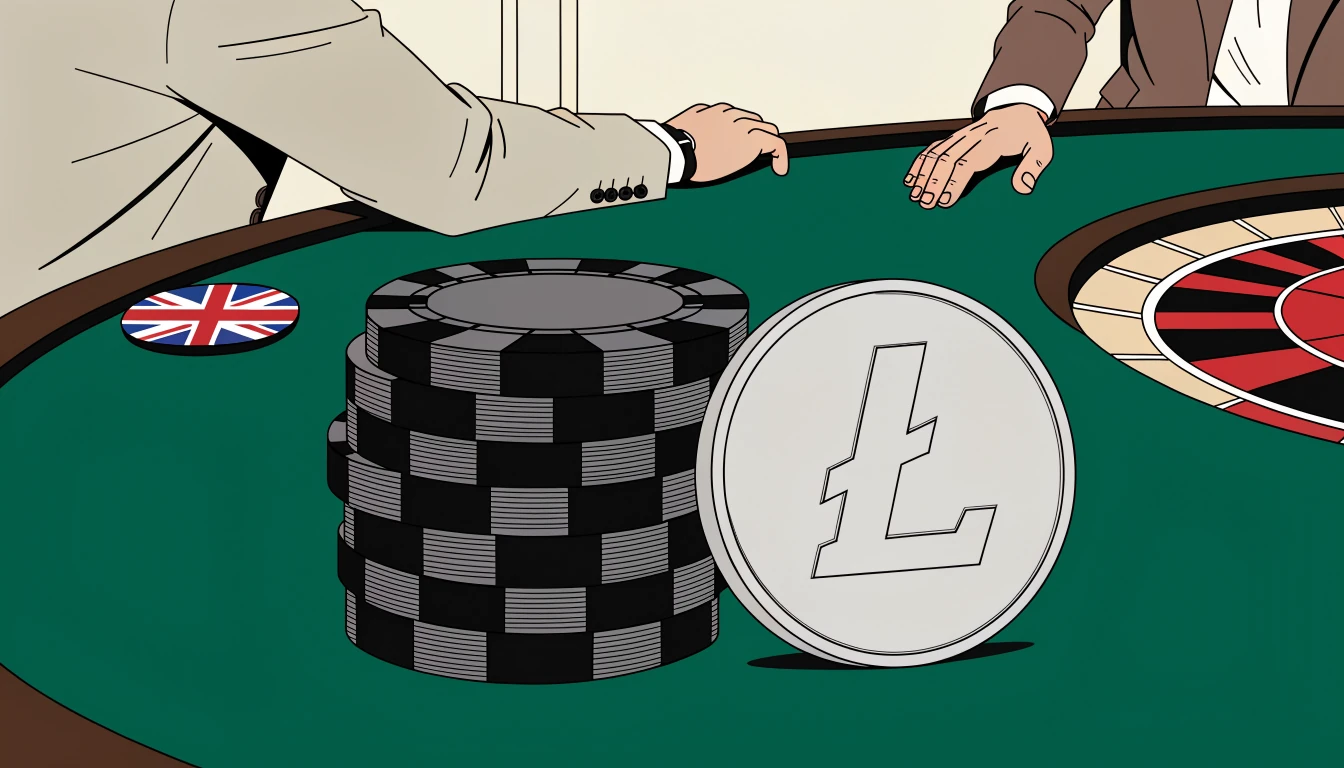
A general reference to cryptocurrency does not confirm Litecoin is available in a casino cashier for a particular account or transaction.
When Litecoin Is—and Is Not—a Casino Payment Option
The phrase “casinos that accept Litecoin UK 2026” suggests a definite list of operators and a payment method ready to use. That is more than can be established. A specialist review of casino payment pages mentions several cryptocurrencies alongside Visa, Mastercard, bank transfer and e-wallets, but it does not verify which named UK-facing casinos accept Litecoin. A broad reference to cryptocurrency is not evidence that Litecoin is supported by a particular cashier.
That distinction matters because crypto is not a single payment option. An operator may list some digital currencies without listing Litecoin, or may describe a method on a general information page that does not match the options shown to an eligible customer at checkout. A casino’s payment page, a review written earlier and a live cashier can therefore answer different questions. Only the cashier can establish whether Litecoin is currently offered for the relevant account and transaction.
This leaves no responsible basis for presenting an “all Litecoin casinos” list or labelling particular sites as the best Litecoin casinos in the UK. Names appearing in casino round-ups cannot be treated as Litecoin-accepting operators unless their current payment information confirms the method. Nor does the existence of several cryptocurrency references prove that support is current, available to UK customers or usable for both deposits and withdrawals. A list built on those assumptions would look precise while leaving its main condition unresolved.
A UK licence and a payment method are separate checks
Payment acceptance does not establish an operator’s regulatory status. Remote gambling licensees serving Great Britain must hold the relevant UK Gambling Commission licence, regardless of where the company is based. Online gambling is legal in the UK for adults aged 18 and over when the operator holds that licence. A cryptocurrency option, if displayed, does not replace the need to confirm that the casino is authorised to serve the British market.
Casinos That Accept Bitcoin in the UK: Evidence and Checks
That separation is particularly relevant when a site promotes itself as a new Litecoin casino. “New” describes a marketing claim, not proof of current UK availability, a UKGC licence or a working Litecoin route. A casino may advertise crypto payments to an international audience while its UK-facing service has different terms. Its country restrictions and licence status must be considered independently from its payment branding.
The same applies to claims about the “best” site, a welcome promotion or a catalogue of games. None can establish Litecoin compatibility. A casino can have an attractive offer and still exclude the payment method, while a payment reference alone says nothing about bonus eligibility or the games available to an account. Those are separate terms, not benefits that can be inferred from a crypto logo.
What “available” needs to mean
A useful claim of Litecoin availability needs to answer several specific points: whether the method is shown to a UK customer, whether the casino permits it for deposits, whether it can also be used for withdrawals, and which account conditions apply. A cryptocurrency name on a general page answers none of those questions by itself. Even an operator’s current payment information should be read in context, because a list of supported methods may not show the options enabled for every account.
The word “available” can also refer to different stages. Litecoin might be mentioned in promotional material but absent from the cashier; it might be offered only in selected countries; or it might appear for deposits without forming an eligible payout route. These are materially different arrangements. Treating them as one confirmed payment option would obscure the point at which a transaction can actually proceed.
Searches for Android casinos accepting Litecoin raise the same issue. A mobile site or app may provide access to a cashier, but the device does not verify which currencies that cashier supports. Mobile compatibility and payment-method availability are separate attributes. The same applies to claims about Litecoin games: game access does not establish how an account can be funded, and payment acceptance does not confirm a particular game selection.
Mobile compatibility and payment-method availability are separate attributes; a mobile-friendly design does not guarantee that a specific cryptocurrency is supported in the mobile cashier.
A cautious answer to whether Litecoin casinos remain available
The evidence supports a limited answer, not a market-wide yes or no. Casino payment material refers to several cryptocurrencies, but it does not confirm a current set of UK operators accepting Litecoin. That makes it inappropriate to say that particular casinos still accept it, or that none do. The defensible position is narrower: individual availability has to be established at operator level, and a general cryptocurrency reference is insufficient.
For the same reason, “best Litecoin casino” claims should be treated as unverified until the underlying method is confirmed for the UK-facing account. Rankings can combine payment claims, offers and site features, but those elements do not cure a missing compatibility check. A dependable comparison begins with the operator’s current UK status and a live confirmation of Litecoin in its cashier; without both, the ranking has no sound payment basis.
Our top casino picks for the UK
- BeOnBetBonus: 100% up to €500 + 100 FS · Payout speed: 1-3 business days
- AmunbetBonus: Join now and get 450% up to 2,700 GBP + 450 FS · Payout speed: 1-3 business days
- Revery PlayBonus: 100% up to€1,000+ 100 FS · Payout speed: 1-3 business days
- JetsetspinsBonus: 200% Bonus + 100 Free Spins + Free Royal Wheel · Payout speed: 1-3 business days
- ChanzeBonus: Slots Welcome Bonus #1 200% up to €500 · Payout speed: 1-3 business days
- BritsinoBonus: Welcome Package – Get your £2,200 + 2,000 FS · Payout speed: 1-3 business days
- DieselwinBonus: Welcome Pack 250% up to £4000 + 200 FS · Payout speed: 1-3 business days
- NightWinBonus: £900 + 400 free spins · Payout speed: 1-3 business days
- SlotoSportBonus: 500% up to £ 10 200+ 777 FS · Payout speed: 1-3 business days
Deposit and Withdrawal Routes When Litecoin Is Unavailable
When Litecoin is not offered in a casino cashier, the practical alternatives are conventional payment routes: debit cards, bank services, e-wallets and, for deposits only, prepaid vouchers. They do not perform the same job. A method that puts funds into an account may not be available for taking a balance out, so the route needs to be assessed by both stages rather than by its deposit label alone.
Debit cards and bank services
Debit cards are among the familiar options at UK casinos, with Visa and Mastercard commonly listed. The distinction between debit and credit matters: UK-licensed casinos cannot accept credit-card payments for gambling. A card bearing one of those network names is therefore not enough to establish eligibility; the product must be a permitted debit card and must appear as available in the casino cashier.
Casinos That Accept Maestro in the UK: What to Check
Open banking and bank transfers provide another route. A specialist review describes these services as capable of supporting instant deposits and fast withdrawals at many sites. That is a site-specific description, not a timing promise for every casino or bank. The cashier determines whether the service is offered, while the payment terms determine whether the same route can receive a payout. A bank transfer may be listed as a deposit method without answering that second question.
Where both deposit and withdrawal are supported, using a bank account in the account holder’s own name keeps the ownership details aligned. That is a practical way to avoid friction caused by mismatched basic information, not a guarantee that a payment will be approved without further checks.
E-wallets and mobile wallet payments
Skrill and Neteller are offered at some casinos. A specialist review characterises Skrill as a common deposit route at UK-friendly sites in 2026, but that does not establish availability at a particular operator or confirm withdrawal support there. The cashier’s separate deposit and withdrawal options are more useful than a general label.
PayPal is another recognised payment option. A specialist review describes it as popular for convenience and speed, while also noting that it may be excluded from bonus eligibility. Those terms can vary by operator, so the method’s presence does not settle whether a promotion applies. Apple Pay is accepted for deposits at some UKGC-licensed casinos; that fact alone does not establish it as a withdrawal route.
E-wallet availability
While Skrill, Neteller, and PayPal are recognised payment options, their availability for both deposits and withdrawals must be explicitly confirmed in the casino’s live cashier.
Apple Pay may be accepted for deposits at some UKGC-licensed casinos, but this does not establish it as a withdrawal route.
Jeton appears at a handful of UK online casinos in 2026, according to a specialist review. Its limited availability makes direct confirmation particularly important. An e-wallet should not be treated as a two-way route unless the casino explicitly lists it for both deposits and withdrawals.
Deposit-only vouchers
Paysafecard is a prepaid voucher for deposits only. It can fund a casino account, but it cannot serve as the route for withdrawing winnings. That makes it a one-way option: a separate payout method must be available, and the casino may apply its own rules when returning funds.
This is a material difference from a card, bank account or e-wallet that the operator accepts on both sides of the transaction. A voucher can solve the funding step without solving the payout step. The final withdrawal route should therefore be established before depositing, rather than left to a later cashier check.
Match the route to the transaction
A useful comparison starts with the job each method can do:
Casinos That Accept Wirecard in the UK: Payment Guide
| Route | Deposit role | Withdrawal role |
|---|---|---|
| Visa or Mastercard debit card | Commonly accepted at UK casinos, subject to card eligibility and cashier availability | Must be confirmed with the operator |
| Open banking or bank transfer | May be available for deposits | A specialist review reports fast withdrawals at many sites; availability remains site-specific |
| Skrill or Neteller | Available at some casinos | Must be confirmed with the operator |
| PayPal | A possible payment route where listed | Must be confirmed with the operator |
| Apple Pay | Accepted for deposits at some UKGC-licensed casinos | Deposit acceptance does not establish payout support |
| Paysafecard | Deposit-only | Not available for withdrawals |
| Jeton | Available at a handful of UK online casinos in 2026, according to a specialist review | Must be confirmed with the operator |
For any route intended to handle both sides, the cleanest arrangement is often one named account used consistently for deposits and withdrawals. UK anti-money laundering controls commonly require payouts to return to the original payment source, although an operator may need to use an alternative route when the original method cannot receive funds. Additional verification may then be required.
The comparison is therefore not simply between payment brands. A card may be convenient for a deposit but not listed for payout; a voucher is explicitly deposit-only; an e-wallet or bank service may support both only where the casino says so. Each method has to be judged by its actual role in the cashier, not by the assumption that every payment instrument works in both directions.
Cashier Checks: Availability, Eligibility and Account Currency
A payment logo on a casino page is not a complete compatibility check. A specialist review lists Visa and Mastercard among the methods covered, but the cashier is the relevant place to confirm current UK availability and whether a particular card product is eligible. A debit card bearing a familiar network mark is not automatically accepted for gambling transactions.
Attention UK-licensed casinos cannot accept credit-card payments for gambling; ensure your card is a permitted debit product before attempting a transaction.
The distinction matters for searches about casinos accepting Litecoin debit cards in the UK. A card and Litecoin are separate payment routes: a casino listing card networks does not establish that it accepts Litecoin, nor does a Litecoin reference establish that a debit card can fund an account. Each method needs to appear as an available option in the operator’s cashier for the account in question. The wording on a general payments page may not reflect the options presented at deposit.
For card eligibility, the product type needs to be clear. UK-licensed casinos cannot accept credit-card payments for gambling. Visa or Mastercard branding alone does not establish that a card is a debit card, and a wallet route is not a workaround where the wallet permits credit-card funds to be used for gambling. The cashier’s permitted options, together with the card issuer’s product details, determine whether the proposed route fits the rules.
The same check should establish what the method can do. A route displayed for deposits is not necessarily available for withdrawals. Paysafecard, for instance, is deposit-only; it should not be treated as a payout route. For other methods, the deposit and withdrawal functions should be checked separately rather than inferred from a logo or a general list. Closed-loop rules also matter: anti-fraud and anti-money-laundering controls commonly return funds to the original payment source. If a different route is needed for a payout, further verification may be required.
Casinos That Accept Dogecoin in the UK: What to Check
Confirm the account currency
Currency is another cashier detail, not a safe assumption based on the casino’s UK-facing presentation. A specialist review reports GBP support on the pages it assessed, but that does not establish the currency setting on every account. The account currency should be confirmed before the first transaction. If the account is denominated in another currency, conversion may enter the payment path; the displayed currency and the account’s actual settlement currency are not interchangeable labels.
This point applies to both conventional methods and any cryptocurrency option. A casino that accepts a digital asset would still need to specify how the balance is credited and withdrawn, including whether the account is held in GBP or another denomination. The existence of a Litecoin option cannot be inferred from a GBP balance, and a GBP account does not by itself confirm that every listed payment method will settle in sterling.
A practical cashier check therefore has four separate outcomes: whether the method is currently offered to UK customers, whether the specific card or account qualifies, whether it supports deposits and withdrawals, and which currency the casino account uses. A method should not be counted as compatible until those points align. The cleanest arrangement is one named account, owned by the same customer, used consistently; mismatched names or payment details can create avoidable friction before a transaction is completed.
Using Litecoin on Mobile Slots
A phone or tablet changes how a slot is displayed; it does not establish that Litecoin is an available payment method. Those are separate checks. A casino page may discuss mobile play and digital currencies in the same place, but that alone does not confirm that a particular mobile casino accepts Litecoin for real-money slots.
Mobile Verification
Confirm that the mobile cashier explicitly offers Litecoin for your specific account, as device compatibility does not guarantee payment availability.
A specialist review of casino websites mentions Visa, Mastercard, bank transfers, e-wallets and several cryptocurrencies. That is a broad description of payment categories, not confirmation of a named Litecoin-ready slot, app or operator. The distinction matters: a currency appearing somewhere on a site does not prove that it can fund a slot session, or that the same route is available on a mobile device.
The mobile experience also has its own practical requirements. A slot may open in a phone browser or within an operator’s app, while the cashier may be handled in a separate screen or service. The payment option shown on a desktop page is not proof that it appears in the mobile cashier. Likewise, a game that runs on a phone does not determine which currencies the casino accepts.
For real-money play, the relevant evidence is the operator’s current cashier and payment terms. The cashier needs to identify Litecoin as an accepted route for the account, rather than merely mentioning cryptocurrency in general. The terms should also make clear whether Litecoin can be used for the intended transaction and whether any conditions apply to the account or the mobile channel. Without those details, “mobile slots with Litecoin” describes a combination of features, not a verified service.
A separate distinction applies to free play. A free slot session does not, by itself, show that Litecoin can be deposited or withdrawn: no real-money payment is necessarily involved. A page that offers a demo or free-play mode therefore cannot establish that the same game is available for real-money play using Litecoin. The game format and the funding method answer different questions.
Casinos That Accept Interac in the UK: Payment Checks
Legitimacy is another matter. A mobile-friendly design, a cryptocurrency logo or a slot catalogue does not establish that an operator is authorised to serve customers in Great Britain. Remote gambling licensees serving the British market must hold a UK Gambling Commission licence. The licence status should be checked on the Commission’s public register; payment branding is not a substitute for that check.
Mobile slot access also remains subject to British rules. Autoplay is not permitted for online slots, and each spin must last at least two and a half seconds. A polished interface does not change those requirements.
The practical test is therefore narrow: confirm the operator’s UK licence, confirm that the mobile cashier explicitly offers Litecoin for the relevant account, and confirm that the slot itself is available for the intended type of play. If one link in that chain is absent, the claim that a slot accepts Litecoin on mobile has not been established.
Real-Money Slot Play and the Cost of a Transaction
A slot balance denominated in pounds and a Litecoin transfer are not the same unit of account. If a casino accepts cryptocurrency, the amount credited can depend on the exchange rate applied when the transfer is valued. A displayed network fee is only one part of the calculation; the amount ultimately available for play may also reflect conversion terms or charges imposed elsewhere in the payment chain.
Calculating Net Credit
Step 1: Initial amount
Start with the total amount of Litecoin sent.
Step 2: Deduct fees
Subtract the casino charge, payment provider fee, and blockchain network fee.
Step 3: Apply conversion
Account for the exchange rate and any spread used to convert the remaining value into the casino’s account currency (e.g., GBP).
For real-money slot play, the relevant figure is the net amount credited, not the number of coins sent. A transaction can involve a casino charge, a payment-provider fee, a bank or issuer charge, an exchange-rate spread and a blockchain network fee. Which of these applies depends on the route and its terms. A specialist payment review notes that a conversion spread can exceed a visible flat charge, so comparing headline fees alone can produce the wrong result.
The arithmetic is straightforward in principle: begin with the amount sent, subtract any stated charges, then account for the exchange rate and any spread used to convert it into the casino’s account currency. The result is the usable balance. Where the account is in pounds but a payment is valued in Litecoin, the conversion point matters: a rate used by the provider, wallet or casino can change the final sterling value. The exchange rate shown at the time of sending may not be the rate used at crediting.
That distinction matters when assessing claims about slots that accept Litecoin or real-money play with Litecoin. A game’s denomination and payout table do not determine what a transfer costs. Nor does a deposit amount by itself show how much reaches the balance after conversion and fees. Any advertised no-deposit claim should be separated from the cost of funding an account: a promotion is not evidence that a payment route is free, available or eligible for the offer.
Casinos That Accept POLi in the UK: What to Check
A useful comparison records the same proposed amount across the full payment path: the casino’s charge, the provider’s charge, any bank or issuer cost, the exchange rate and spread, and the network fee. The calculation should use the actual amount intended for the transaction, because fixed charges and percentage-based conversion costs do not affect every payment equally. There is no single payment method that can be identified as the cheapest in every case; the net cost depends on the combination of terms applied to that transaction.
For UK real-money play, the operator’s regulatory status is a separate condition from payment economics. A remote gambling licensee serving Great Britain must hold a UK Gambling Commission licence. That does not establish that it accepts Litecoin, or that any quoted conversion route has a particular cost. The financial comparison remains specific to the operator, the payment service and the account currency in use.
The decision point is therefore the final sterling balance after all applicable charges and conversion, not a low-looking fee in isolation. If the cashier or provider does not disclose the rate, spread or fee before confirmation, the total cost cannot be calculated reliably from the headline amount.
Deposits, Payouts and Verification Delays
A deposit confirmation records that funds reached the casino account; it does not establish how quickly a withdrawal will be processed. Payout timing includes the operator’s internal approval, the account’s verification status and the route used to return funds. A payment that appears immediate at the deposit stage can therefore be followed by a separate review before any withdrawal is released.
Do
- Confirm the operator holds a valid UK Gambling Commission licence.
- Use one named account consistently for both deposits and withdrawals.
- Check the live cashier for current availability and withdrawal support.
Don’t
- Assume a deposit method is also available for withdrawals.
- Treat a general cryptocurrency reference as proof of specific Litecoin support.
- Rely on promotional labels to verify payment eligibility.
A specialist review describes withdrawal speed as dependent on both the casino’s approval process and whether the account is fully verified. It also notes that an initial withdrawal can take longer while checks are completed. The distinction is operational: the deposit is one transaction, while a withdrawal may require the operator to confirm identity, account ownership and payment details before authorisation.
UK anti-money laundering rules generally require winnings to go back to the original payment source. This closed-loop approach means a requested payout is not necessarily sent by whichever route seems quickest at the moment. If a payment method cannot receive withdrawals, the casino may need to use another eligible route, with additional checks before funds can be released. Returning funds to the same source also reduces avoidable mismatch between the account holder and the payment details.
For anyone considering a Litecoin deposit, the same timing distinction matters. A cryptocurrency transfer reaching a casino wallet would not, by itself, prove that the casino supports direct Litecoin withdrawals or that a payout would be immediate. The relevant terms are the cashier’s withdrawal options and the operator’s verification requirements, not the speed of the deposit confirmation. A phrase such as “instant banking” describes neither the casino’s approval time nor the completion of a later payout.
The payment account and casino account should belong to the same customer. Differences in names or ownership details can create additional questions at the point of withdrawal, even where the original deposit went through. If the operator requests documents or clarification, the payout remains subject to that review; a rapid deposit does not remove the verification stage.
Casinos That Accept Citadel in the UK: How to Check
A Litecoin-related bonus or no-deposit promotion is a separate matter from payout processing. Promotion eligibility does not establish that a particular withdrawal route is available, and the bonus terms cannot override identity checks or closed-loop controls. Each condition affects a different part of the transaction.
The useful comparison is therefore not “fast deposit” versus “slow deposit”, but deposit confirmation versus approved withdrawal. Before treating any payment route as suitable for direct payouts, the account’s verification status, the casino’s approval step and the permitted return route all need to align.
Bonuses and Payment-Method Conditions
A Litecoin deposit does not, by itself, establish eligibility for a welcome offer. Promotion terms attach to the operator, the account and the payment method accepted for that offer. Without a confirmed operator-specific rule, a Litecoin welcome bonus, no-deposit promotion or bonus code cannot be treated as available. A page advertising real-money slots and Litecoin payments is not proof that those two features qualify together.
The payment clause should be checked before a promotion is activated. It may name excluded methods, set a qualifying deposit route or require the first deposit to be made through an eligible method. If Litecoin is absent from the stated terms, eligibility remains unresolved; it should not be inferred from the fact that the cashier accepts the currency. The practical calculation is simple: a bonus has value only if the selected deposit route qualifies and the remaining conditions can be met.
Bonus eligibility depends on specific operator rules; some methods like PayPal, Skrill, or Neteller may be explicitly excluded from certain promotions.
A specialist review reports that PayPal may be excluded from bonus eligibility, while a separate specialist review describes Skrill and Neteller as methods often excluded from promotions. These are not universal operator rules. The current offer terms take precedence, and the payment-method exclusion list can differ between promotions at the same site. A method described as available for deposits may still be excluded from a particular bonus.
The distinction matters for Litecoin slot promotions as well. A bonus labelled for slots does not automatically cover every payment route, and a bonus code does not override the written eligibility conditions. The terms should identify eligible deposits, excluded methods, any game restrictions and what happens if a qualifying deposit is made through an excluded route. If those points are unclear, the bonus value cannot be calculated reliably.
A no-deposit offer also needs its own terms; its label does not establish that it is compatible with Litecoin or that a code is required. The decisive information is the operator’s current promotion wording, not a general claim about Litecoin casinos. Until that wording confirms the method and offer together, the defensible figure for the bonus is zero.
Minimum Deposits, Limits and Financial Controls
A specialist review places common minimum deposits in a range from £10 to £20, with the threshold depending on the payment method. That range is not a Litecoin-specific minimum: the amount available for a particular cryptocurrency, if offered, has to be established from the casino’s own cashier. A low advertised entry point does not establish that Litecoin is accepted or that the same threshold applies to it.
Casinos That Accept Monzo in the UK: Payment Guide
Deposit ceilings are separate from minimums. They may apply per transaction, per day or per month, and can vary with the payment route and the customer’s account status. The amount a cashier permits at one stage is therefore not necessarily the limit for another route or a later transaction. Any Litecoin figure labelled as a minimum deposit should be treated as method-specific only if the cashier identifies Litecoin and displays that amount for the relevant account.
For UK customers, financial controls begin before the first deposit. UK Gambling Commission rules require remote gambling licensees to prompt new customers to set a financial limit before allowing that deposit. Account-level limit controls must also be accessible after registration, so limits are not confined to the initial setup screen.
A deposit limit and a personal financial limit are not the same control. The first is a transaction cap set by the payment method or operator; the second is an account tool for managing gambling spend. A customer-set limit may restrict activity below the amount the cashier would otherwise accept. The displayed transaction maximum does not override that control.
For a proposed small deposit, the relevant comparison is the selected method’s minimum, any transaction cap, and the account’s active financial limit. Where a cryptocurrency route is not shown in the cashier, a £5 figure found elsewhere does not make it a usable deposit option. The practical amount is the lowest figure the operator actually permits for that account and method, subject to the customer’s own controls.
Financial Safety Check
- Set a personal financial limit via account tools.
- Confirm the minimum deposit amount for your chosen method.
- Verify if the account currency matches your intended payment.
- Check if the operator requires identity verification for withdrawals.
Comparing Payment Alternatives by Speed and Total Cost
A payment route is not cheaper simply because the cashier shows no charge. The useful comparison is the amount credited, the amount received on withdrawal and the time between those points. A specialist review identifies PayPal, open banking services and debit cards connected to fast payout systems as options that can rank among the quicker withdrawal routes. That is a reported comparison, not a timing commitment: the casino’s approval and the payment provider’s processing still matter.
Cards illustrate why deposit speed and payout speed need separate columns. A card deposit may appear instantly, while a withdrawal can take several business days. The first figure says little about access to winnings. Open banking may support instant deposits and fast withdrawals at many sites, but the specific service and cashier terms determine whether both directions are available.
Bank transfers need a different calculation. Delivery can be affected by the bank’s cut-off time and weekends; conversion can add another variable if the account and payment are not in the same currency. A transfer that looks inexpensive in the cashier may therefore cost more in practice once exchange rates and bank charges are included.
Casinos That Accept eCheck in the UK: Payment Guide
For any route, total cost can include a casino charge, a provider fee, an issuer or bank fee, an exchange-rate spread and, for cryptocurrency, a network fee. The spread is not always displayed as a separate line and can exceed a flat charge. Compare the amount debited with the value credited, then check what would be deducted or converted on withdrawal. There is no universal lowest-cost method: the result depends on the payment amount, currency and charges actually applied.
For someone weighing a Litecoin deposit alternative, the relevant test is not whether a method sounds faster or cheaper. It is whether the same route supports the intended deposit and withdrawal, what arrives after every fee and conversion, and how long the payout takes after casino approval. A named account used consistently for both sides can also reduce avoidable ownership checks. The lowest visible fee is a poor bargain if conversion quietly takes the difference.
Casinos That Accept Boku in the UK: Payment Guide
Litecoin and GamStop: Separate Questions to Verify
Litecoin acceptance and GamStop status are separate characteristics. A payment method does not establish whether a casino is connected to the self-exclusion scheme, and a site described as outside GamStop is not thereby confirmed to accept Litecoin. Each point requires its own check; combining them into a single label can obscure the terms that matter.
For gambling offered to customers in Great Britain, a remote gambling licensee must hold a current UK Gambling Commission licence. That status brings formal protections: licensed casinos must provide self-exclusion tools, an internal complaints process and access to an approved Alternative Dispute Resolution service. The licence can be checked against the Commission’s public register. These safeguards are relevant when assessing account access and disputes; they do not confirm that a particular payment route is available.
GamStop is an account-security question, not a payment feature. Where self-exclusion is in place, seeking another site because it is not connected to the scheme can undermine that protection. A cryptocurrency label does not change the purpose of self-exclusion or establish that a site is suitable for someone who has chosen it.
Transaction details also need to align with the account holder. Using account information and a payment route belonging to the same person reduces avoidable friction over basic ownership checks. The cleanest arrangement is often one named account used consistently for deposits and withdrawals. A mismatch can create questions even when the payment itself appears to have gone through.
For searches combining Litecoin with casinos outside GamStop, the useful distinction is between what can be checked independently: the operator’s licence status, the site’s stated connection to self-exclusion, and the payment terms shown in its cashier. None substitutes for another. A claim about Litecoin does not establish regulatory status; a claim about GamStop does not establish that Litecoin deposits or withdrawals are supported.
What is the fastest withdrawal method for UK casinos?
PayPal, open banking services and debit cards linked to fast payout systems are generally among the quickest options. Actual speed also depends on casino approval and whether your account is verified.
Do UK casino withdrawals require verification?
Verification may be needed, particularly before a first withdrawal, and it can delay processing. A fully verified account is less likely to face this hold-up.
Why can a fast payout casino still delay my withdrawal?
A casino must approve the withdrawal internally, and checks may take longer for a first payout while verification is completed. Bank cut-off times and weekends can also affect delivery.
Why must withdrawals return to the deposit method?
Returning funds to the original payment source is a common anti-fraud and anti-money-laundering control. An alternative payout route may require additional verification.
What is the current minimum deposit?
The minimum deposit usually starts at £10–£20, depending on the payment method.
Are fast casino withdrawals guaranteed?
No. Withdrawal speed depends on the casino’s approval process, account verification and, for bank transfers, cut-off times and weekends.
Payments
Casinos That Accept Wirecard in the UK: Payment Guide
Wirecard labels, card networks and casino cashier options are not interchangeable, and acceptance depends on the specific card product and site. Wirecard and UK Casino Payments in 2026: What Still…
Casinos That Accept Siru Mobile in the UK
Siru Mobile is one of several distinct pay-by-phone routes, with deposit limits,…
UK Casino Sites That Accept Credit Cards: The Rules
UK rules prohibit credit-card gambling deposits, while wallet use, alternative payment methods…
Casino Sites That Accept Skrill in the UK
Skrill availability varies by operator, so payment terms, licensing, withdrawal routes and…
Created by the "StakeVault" editorial team.